

Noble Gas Configuration Of Fluorine
Chemistry of Fluorine (Z=ix)
- Page ID
- 578
Fluorine (F) is the first element in the Halogen group (group 17) in the periodic table. Its atomic number is 9 and its diminutive weight is xix, and it's a gas at room temperature. It is the most electronegative element, given that it is the top element in the Halogen Grouping, and therefore is very reactive. Information technology is a nonmetal, and is one of the few elements that can form diatomic molecules (F2). It has five valence electrons in the 2p level. Its electron configuration is 1sii2stwo2p5. It will usually form the anion F- since it is extremely electronegative and a stiff oxidizing agent. Fluorine is a Lewis acrid in weak acid, which means that information technology accepts electrons when reacting. Fluorine has many isotopes, just the only stable one found in nature is F-19.
Brief History
In the belatedly 1600's minerals which nosotros now know contain fluorine were used in etching drinking glass. The discovery of the chemical element was prompted past the search for the chemical substance which was able to attack glass (it is HF, a weak acid). The early on history of the isolation and piece of work with fluorine and hydrogen fluoride is filled with accidents since both are extremely dangerous. Eventually, electrolysis of a mixture of KF and HF (carefully ensuring that the resulting hydrogen and fluorine would not come in contact) in a platinum appliance yielded the element.
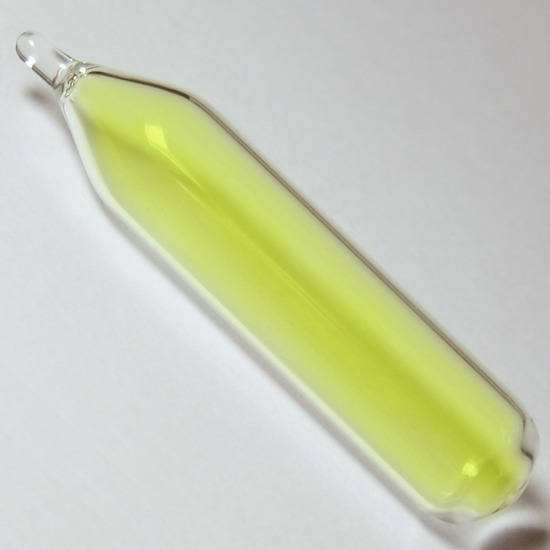
Fluorine was discovered in 1530 by Georgius Agricola. He originally constitute it in the compound Fluorspar, which was used to promote the fusion of metals. It was under this application until 1670, when Schwanhard discovered its usefulness in etching glass. Pure fluorine (from the Latin fluere, for "flow") was was non isolated until 1886 by Henri Moissan, burning and even killing many scientists along the manner. It has many uses today, a particular one being used in the Manhattan project to help create the first nuclear flop.
Electronegativity of Fluorine
Fluorine is the most electronegative element on the periodic tabular array, which means that it is a very strong oxidizing agent and accepts other elements' electrons. Fluorine's diminutive electron configuration is 1sii2s22p v . (run across Figure ii)
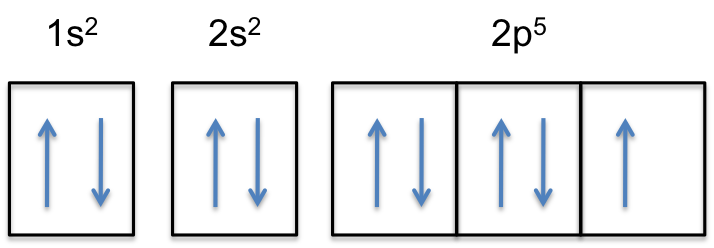
Fluorine is the about electronegative chemical element because it has 5 electrons in it'due south 2P shell. The optimal electron configuration of the 2P orbital contains 6 electrons, so since Fluorine is so shut to ideal electron configuration, the electrons are held very tightly to the nucleus. The loftier electronegativity of fluorine explains its pocket-size radius considering the positive protons accept a very potent attraction to the negative electrons, belongings them closer to the nucleus than the bigger and less electronegative elements.
Reactions of Fluorine
Because of its reactivity, elemental fluorine is never institute in nature and no other element can displace fluorine from its compounds. Fluorine bonds with nearly any element, both metals and nonmetals, considering information technology is a very strong oxidizing amanuensis. It is very unstable and reactive since it is so shut to its ideal electron configuration. It forms covalent bonds with nonmetals, and since it is the nearly electronegative element, is always going to be the element that is reduced. It can besides form a diatomic element with itself (\(F_2\)), or covalent bonds where it oxidizes other halogensouth (\(ClF\), \(ClF_3\), \(ClF_5\)). Information technology volition react explosively with many elements and compounds such as Hydrogen and water. Elemental Fluorine is slightly basic, which means that when it reacts with water it forms \(OH^-\).
\[3F_2+2H_2O \rightarrow O_2+4HF \tag{i}\]
When combined with Hydrogen, Fluorine forms Hydrofluoric acrid (\(HF\)), which is a weak acrid. This acrid is very dangerous and when dissociated can cause severe impairment to the torso because while it may not be painful initially, it passes through tissues quickly and tin can cause deep burns that interfere with nervus function.
\[HF+H_2O \rightarrow H_3O^++F^- \tag{2}\]
At that place are also some organic compounds made of Fluorine, ranging from nontoxic to highly toxic. Fluorine forms covalent bonds with Carbon, which sometimes form into stable aromatic rings. When Carbon reacts with Fluorine the reaction is complex and forms a mixture of \(CF_4\), \(C_2F_6\), an \(C_5F_{12}\).
\[C_{(s)} + F_{2(g)} \rightarrow CF_{4(k)} + C_2F_6 + C_5F_{12} \tag{3}\]
Fluorine reacts with Oxygen to form \(OF_2\) because Fluorine is more than electronegative than Oxygen. The reaction goes:
\[2F_2 + O_2 \rightarrow 2OF_2 \tag{4}\]
Fluorine is so electronegative that sometimes information technology will even form molecules with noble gases like Xenon, such as the the molecule Xenon Difluoride, \(XeF_2\).
\[Xe + F_2 \rightarrow XeF_2 \tag{5}\]
Fluorine likewise forms strong ionic compounds with metals. Some mutual ionic reactions of Fluorine are:
\[F_2 + 2NaOH \rightarrow O_2 + 2NaF +H_2 \tag{6}\]
\[4F_2 + HCl + H_2O \rightarrow 3HF + OF_2 + ClF_3 \tag{seven}\]
\[F_2 + 2HNO_3 \rightarrow 2NO_3F + H_2 \tag{8}\]
Applications of Fluorine
Compounds of fluorine are present in fluoridated toothpaste and in many municipal h2o systems where they help to prevent tooth decay. And, of course, fluorocarbons such as Teflon have fabricated a major impact on life in the 20th century. There are many applications of fluorine:
- Rocket fuels
- Polymer and plastics production
- teflon and tefzel production
- When combined with Oxygen, used as a refrigerator cooler
- Hydrofluoric acid used for glass carving
- Purify public water supplies
- Uranium production
- Ac
Sources
Fluorine can either be institute in nature or produced in a lab. To make it in a lab, compounds like Potassium Fluoride are put through electrolysis with Hydrofluoric acid to create pure Fluorine and other compounds. It can exist carried out with a diversity of compounds, usually ionic ones involving Fluorine and a metal. Fluorine can also be establish in nature in various minerals and compounds. The two main compounds information technology can exist found in are Fluorspar (\(CaF_2\)) and Cryolite (\(Na_3AlF_6\)).
References
- Newth, G. S. Inorganic Chemistry. Longmans, Light-green, and Co.:New York, 1903.
- Latimer, Wendell One thousand., Hildebrand, Joel H. Reference Volume of Inorganic Chemistry. The Macmillan Visitor: New York, 1938.
Problems
(Highlight to view answers)
1. Q. What is the electron configuration of Fluorine? of F-?
A. 1stwo2sii2pv
1s22s22psix
2. Q. Is Fluorine usually oxidized or reduced? explain.
A. Fluorine is unremarkably reduced because it accepts an electron from other elements since it is and so electronegative.
3. Q. What are some mutual uses of Fluorine?
A. Toothpaste, plastics, rocket fuels, glass carving, etc.
4. Q. Does Fluorine form compounds with nonmetals? if then, give 2 examples, ane of them being of an oxide.
A. OF2, ClF
5. Q. What grouping is Fluorine in? (include name of group and number)
A. 17, Halogens
Contributors and Attributions
- Rachel Feldman (University of California, Davis)
-
Stephen R. Marsden

Noble Gas Configuration Of Fluorine,
Source: https://chem.libretexts.org/Bookshelves/Inorganic_Chemistry/Supplemental_Modules_and_Websites_%28Inorganic_Chemistry%29/Descriptive_Chemistry/Elements_Organized_by_Block/2_p-Block_Elements/Group_17:_The_Halogens/Z009_Chemistry_of_Fluorine_%28Z9%29
Posted by: tracyappot1978.blogspot.com
0 Response to "Noble Gas Configuration Of Fluorine"
Post a Comment